Refunds, reversed deposits, and chargebacks: an iGaming payments guide

Understand failed payments, reversed deposits, refunds, and chargebacks, and learn how to handle final Lightning payments in iGaming.
A player makes a deposit. Their balance updates. They start playing.
From their side, the payment is done. For your team, that may not be the end of it. A card payment can become a dispute. A bank debit can come back unpaid. Or the player may contact support with a reasonable request for a refund.
Those situations can all put money back in the player's hands, but they are different problems. Treating them as the same thing makes life harder for everyone.
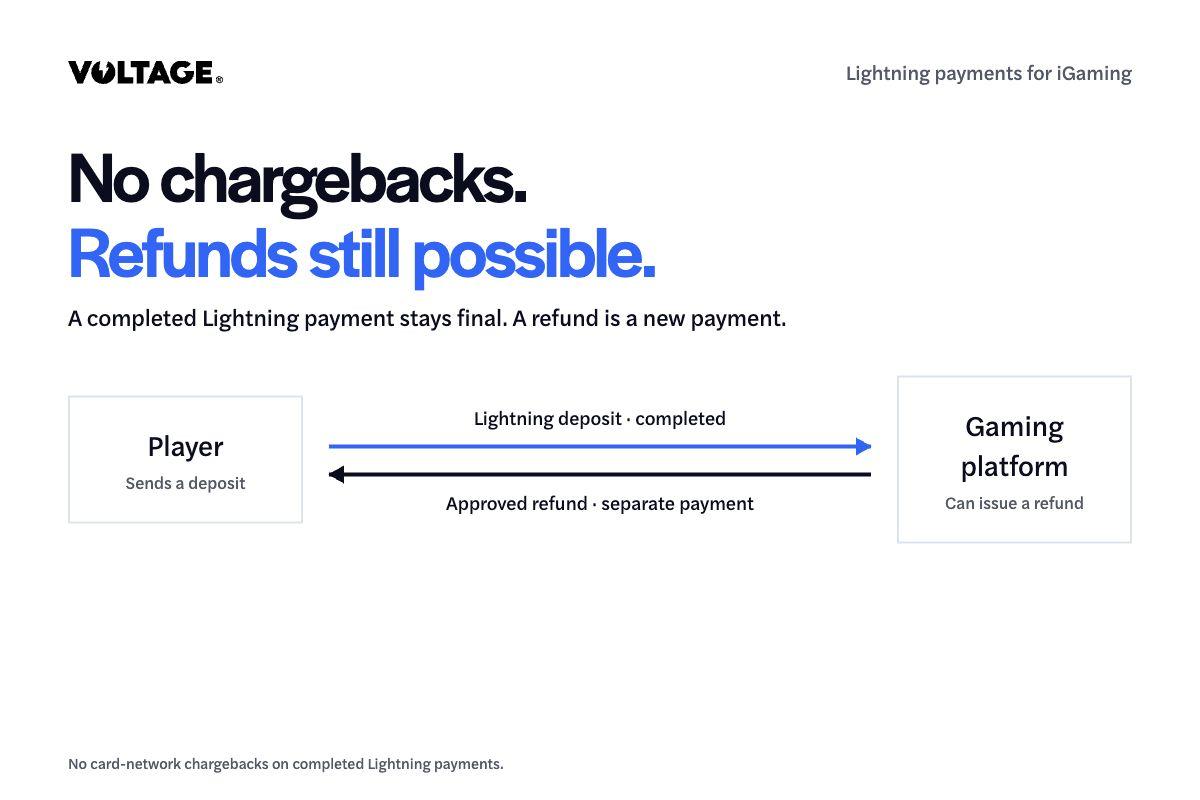
This is one reason we're excited about Lightning for iGaming. A completed Lightning payment has no card-network chargeback process. Your team can still issue an approved refund, but a card issuer cannot reverse that Lightning payment weeks later.
With the Voltage Payments API and managed Lightning infrastructure, you can build that kind of deposit and payout experience without building the payment infrastructure yourself. Your team stays focused on the player experience, the rules for moving money, and keeping accurate records.
First, what actually happened to the payment?
Before support sends money or finance adjusts a balance, answer one question: did the original payment complete?
A failed payment never successfully completed. Think of a declined card or a Lightning payment that failed to reach its destination. You need to explain the outcome and help the player try again. You do not automatically owe a refund for money you never received. A pending bank hold or an unclear payment status needs checking first.
A refund is money your business sends back. The original payment succeeded, and you return some or all of it under your refund policy and applicable requirements. A refund can be good customer service. It is not automatically a sign of fraud. Payment providers distinguish refunding a successful payment from canceling an incomplete one.
A reversed deposit means a previously credited deposit has been taken back or corrected. That is a useful description of what the player sees, but it is not a complete explanation. A released card authorization, a returned bank debit, and an internal balance correction have different causes. Record the actual reason instead of putting everything into a “reversed” bucket.
A chargeback starts through the cardholder's bank. The player disputes a card payment, and the card-network process can pull funds back while the dispute is reviewed. Your team may have to submit evidence to challenge it. That is different from your support team approving a refund. Stripe explains how funds move during a card dispute here.
The distinction matters because the next step changes. You should not send a new refund for a payment that has already been returned.
The same deposit looks different on each payment method
Let's use a simple example: a player wants to add $100 to their account.
With a card, an approval tells you the issuer authorized the payment. Capture and settlement follow. Even after the money reaches you, the payment can still be disputed. If you issue a refund, that has its own process and status to track.
With a bank debit, the request can be underway before the final outcome is known. For example, ACH Direct Debit can fail or be disputed after the initial request. Crediting a player before the payment is confirmed means your business is accepting that exposure. This is specific to the payment method; not every bank transfer works the same way. Stripe's ACH guide explains the delayed confirmation and return risk.
With Lightning, the player sends bitcoin to pay a request. Creating that request does not mean you've been paid. Once the payment completes, it is settled, with no card-style chargeback attached to that Lightning transfer. If your platform displays balances in dollars, make the conversion terms clear to the player.
That is the practical benefit: a completed deposit does not enter a card dispute window. Our earlier guide to eliminating chargebacks in online payments and gaming covers the broader business case.
Lightning removes this particular source of uncertainty. It does not remove every kind of fraud, or erase exposure from a separate card or bank transaction used to fund a wallet.
Only add the money once you've confirmed it arrived
Players should not need to understand payment systems to know whether they can play. Give them a clear status: waiting for payment, deposit received, or payment unsuccessful.
Behind that simple message, your system needs a dependable rule: only credit the player's balance after confirming the deposit completed and matches the expected account, amount, and currency.
Voltage's receiving documentation distinguishes a payment request waiting for funds from a completed payment. Your backend should make that decision using the payment record, not a screenshot or a player's browser returning to a success page.
There is one more detail worth getting right: the same notification may reach your system more than once. That should never turn one deposit into two balance credits.
Give each payment a unique reference and make sure your system records the credit only once. Voltage's webhooks, which are automatic payment updates sent to your server, help your team keep track. Verify those updates and regularly compare your records with Voltage's payment records to catch anything missed.
The player gets a simple experience because your team has a clear record of what happened.
You can still give a Lightning refund
“No chargebacks” does not mean “no refunds.”
Suppose a player's Lightning deposit completed and your team approves a refund. You do not undo the original payment. You send a separate payment back and connect the two in your records.
A practical refund process looks like this:
- Check the original deposit. Confirm it completed, belongs to the player, and has not already been refunded.
- Approve the amount. Follow your refund policy and applicable requirements. Be clear about whether the refund is a bitcoin amount or a dollar value converted at an agreed rate.
- Confirm where it should go. Collect and verify the player's receiving details through your approved process. Do not assume the original deposit request can receive a refund.
- Send and track the refund. Keep a separate payment reference, linked to the original deposit and support case.
- Tell the player when it completes. A request being accepted for processing is not the same as the money arriving.
If a connection drops while sending, check the existing payment before creating another one. Otherwise, an impatient retry can become a second refund. Our guide to designing a reliable Lightning payout system walks engineering teams through that problem.
For support, the record should answer ordinary questions: what came in, what went back, who approved it, and whether the refund finished. Nobody should have to reconstruct that from a long chat thread.
What this changes for an iGaming business
Chargebacks take more than the disputed amount. They take time from people who could be helping players, improving the product, or fixing the next issue.
Our 2026 iGaming Payments Benchmark Report compares traditional payments, on-chain bitcoin, and Lightning across settlement speed, fees, chargebacks, and reach. It is a useful starting point for looking at payments as part of the whole player experience.
For this particular problem, the benefit is straightforward: completed Lightning deposits remove card-network chargebacks from those payments. Your team can spend less time defending those deposits and more time handling legitimate customer needs.
Good operations still matter. Keep account security, player verification, responsible gaming controls, and clear refund policies in place. Final settlement makes the payment outcome clearer; it does not decide whether a player is eligible to deposit or whether a refund is owed.
Start with a payment flow you can explain
You do not need to replace every payment method at once. Start with an eligible player group and a clear deposit-and-refund flow. Test successful payments, unpaid requests, duplicate notifications, and refunds before opening it more widely.
Then watch what matters: payment success, time until funds are available, support questions, refund completion, and chargeback costs on the card flows that remain.
We built Voltage to make Bitcoin and Lightning payments easier for businesses to use. For iGaming, that means a way to accept final payments while still taking care of players when something needs to be put right.
Explore Voltage for iGaming, or schedule a strategy session to talk through where Lightning fits your deposits, withdrawals, and refunds.