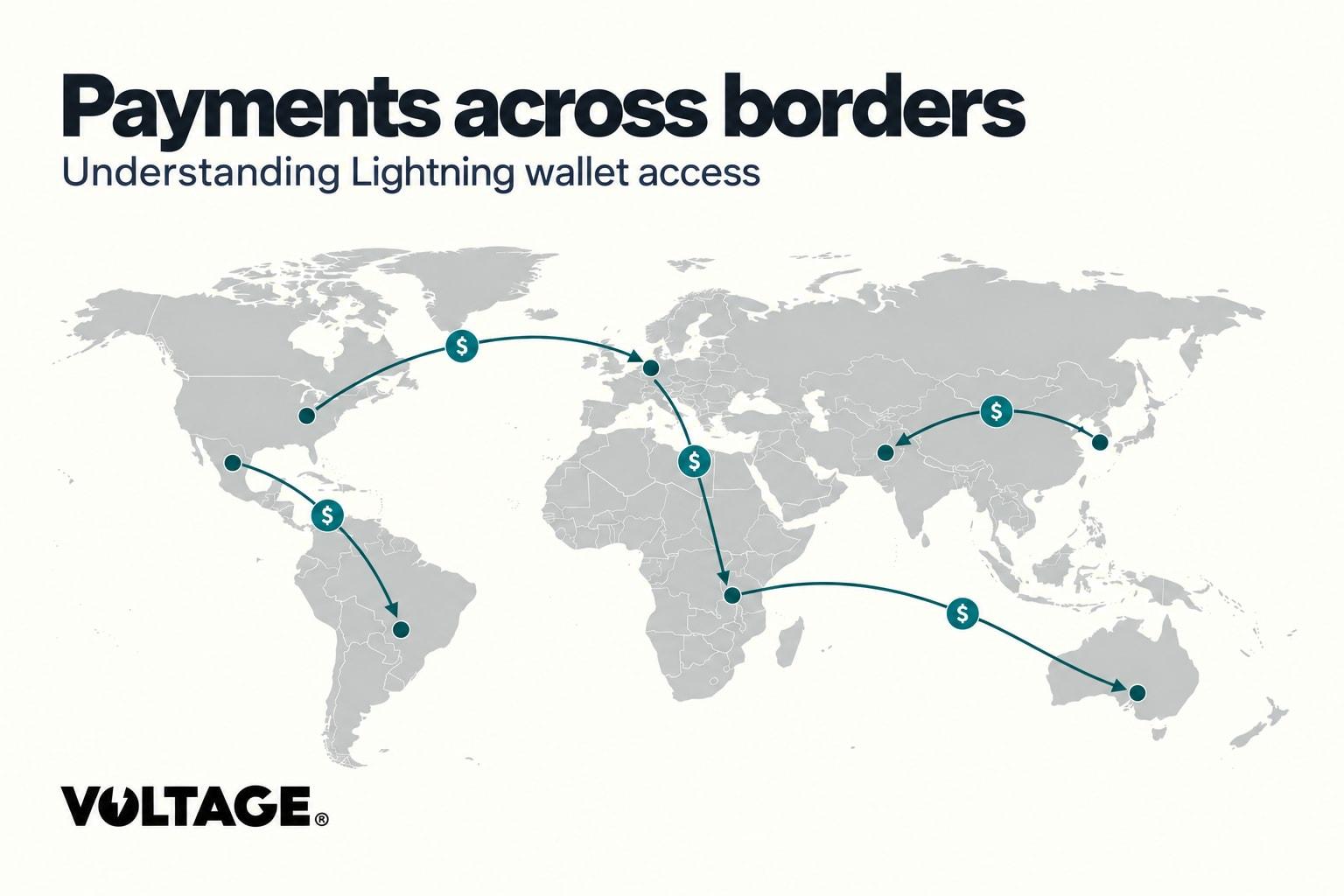
iGaming payments in the Americas and beyond: what Lightning wallet access really means

Learn how to assess Lightning wallet access, player eligibility, deposits, and withdrawals before expanding your iGaming business into a new market.
If you're expanding an iGaming business into a new market, you need to know how players will get money in and out. A payment option only helps if people can use it, understand it, and get their money when they withdraw.
Lightning gives you a useful way to connect those payments. Different wallets can send and receive through the same network, and the Voltage Payments API lets your team build those flows with managed infrastructure behind them.
That opens up possibilities across markets. But before you add a wallet logo to your checkout or put a big audience number in your expansion plan, you need to check what that wallet actually allows for your players.
Here's how we'd approach it.
Start with the player, then look at the wallet
Picture someone opening your deposit page on their phone. They already have a payment app they trust. Ideally, they can use it to pay, see their balance update, and get on with what they came to do.
Lightning can support that experience when their wallet can send the payment and permits the use. The network connects the wallet and your platform without requiring both sides to use the same app.
Still, an app offering bitcoin doesn't automatically mean it supports Lightning. And a wallet that can send a Lightning payment may have different requirements for receiving one.
For each market, start with a few practical questions:
- Which wallets do your players already use?
- Can eligible users send and receive over Lightning?
- Does the provider allow your type of gaming business?
- What limits, fees, and verification steps will players encounter?
- How will players use or convert the money after a withdrawal?
The answers give you a much better starting point than a list of popular apps.
Cash App shows how simple the payment experience can become
In its November 2025 announcement, Cash App described Bitcoin Payments with USD. Eligible customers could fund a Lightning payment from their dollar balance, while the merchant received bitcoin.
That makes the idea easier to understand: a customer can pay from a familiar balance while Lightning handles the transfer. They don't necessarily need to buy and hold bitcoin first.
For an iGaming business, eligibility still needs its own check. Cash App's acceptable use policy restricts gambling, with an exception for legal activity involving merchants approved by the company and its banking partners.
We're using Cash App as a public example of what an open payment network can support. It isn't a Voltage partnership or confirmation that a particular gaming business can accept those payments. A U.S. product announcement also doesn't establish availability elsewhere in the Americas.
You can see this in our work with Higlobe. U.S.-based payers can open a Higlobe payment link and pay through a Lightning-enabled wallet, with Voltage providing the infrastructure behind the payment. Higlobe handles the recipient's experience. For gaming teams, the useful takeaway is how different apps can connect through Lightning while keeping the payment process simple.
Plan each market on its own terms
A launch in the United States, Brazil, or Mexico deserves its own payment plan. The same applies when you look beyond the Americas.
For each location, confirm where your business can operate, which providers permit the payment flow, and what customers can do with their wallets. Work through those questions with your compliance team and payment providers before inviting players into a pilot.
Then test the everyday experience. Can someone fund the wallet easily? Is the minimum payment sensible for your players? Does the withdrawal process make sense on a phone? Are conversion costs clear?
Lightning gives you a shared network to build on. Your rollout still needs to reflect how people pay in each market.
You may decide to keep local payment methods alongside Lightning. Giving players a familiar option while you test a new one can make the rollout easier to manage.
Count completed payments, not just app accounts
A wallet's total account count won't tell you how many customers you can serve.
Some people have several wallets. Some accounts are inactive. Others can't use the relevant feature in their location, or don't meet the provider's requirements. Even eligible users may prefer another payment method.
For your own pilot, track the path from seeing Lightning at checkout to completing a payment. Measure how many eligible players try it, how many succeed, and where they need help.
Look at withdrawals separately. Record how long players wait, what they pay, and whether they can receive funds in the wallet they want to use.
Those results help you decide where to expand. They also give your team a realistic way to compare Lightning with the options you already offer.
Test the whole journey with Voltage
We built the Voltage Payments API so your team can send and receive payments over Lightning while we handle the managed payment infrastructure. Our iGaming payment solutions are a starting point for discussing how that fits your deposit and withdrawal flows.
For a first pilot, choose one permitted market, a small set of eligible wallets, and a clear payment range. Test a deposit, a withdrawal, and a refund from beginning to end.
On deposits, show the player that the payment succeeded only after you confirm completion. Creating a payment request doesn't mean the money has arrived. Our receiving payments guide explains the statuses your developers should check.
On withdrawals, make sure a repeated click or connection problem can't cause your system to pay twice. Our guide to building reliable Lightning payouts walks through that work.
A completed Lightning transfer has no card-style chargeback process. You still need a refund process and controls for fraud, player eligibility, and any risks in how funds entered the wallet. Treat those as part of running the payment service well.
Choose your next market with evidence
Our view is simple: start where you can give players a good deposit and withdrawal experience, then expand using what you learn.
Compare the full cost, payment success, support workload, and time it takes players to receive their money. Our 2026 iGaming Payments Benchmark Report provides a broader comparison of payment methods to support that discussion. Your own pilot will show how they perform for your business.
If you're considering Lightning for a new market, book a strategy session with us. Bring the markets you want to serve, the wallets your players use, and your payout needs. We can help you work through the payment flow and plan a practical first test.